
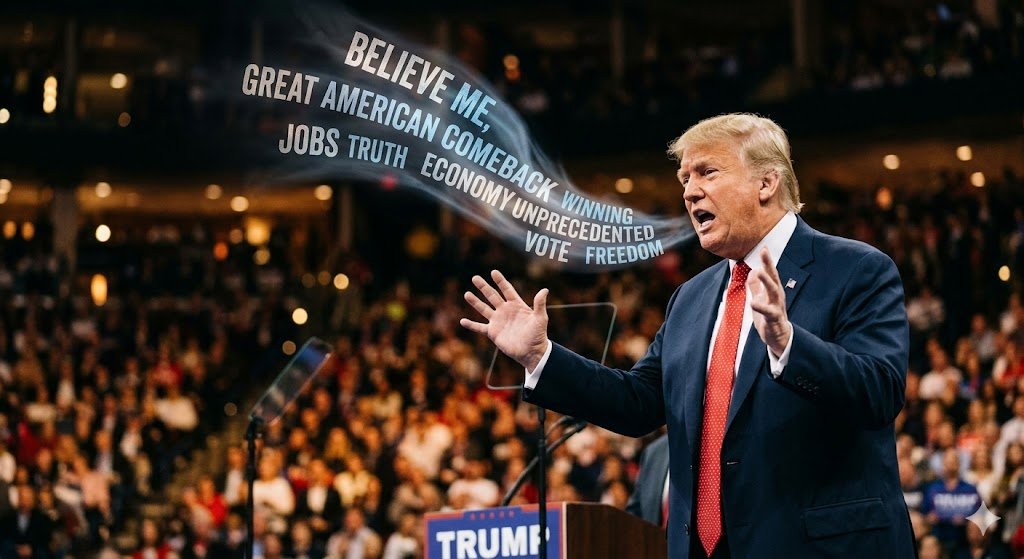
The report — originally released in January 2021 — has recently gone viral again.
During his first term as President of the United States, Donald Trump made an astonishing 30,573 false or misleading claims, according to the comprehensive fact‑checking database maintained by The Washington Post.
The report — originally released in January 2021 — has recently gone viral again, reigniting global debate about political truth, accountability, and the role of fact‑checking in modern discourse.
Compiled over four years, the database tracked Trump’s statements from speeches, interviews, press briefings, and social media posts. Averaging more than 20 questionable claims per day, it offers one of the most detailed records of misinformation tied to a presidency in recent history. While many entries were brief, repetitive, or narrowly technical, a number of larger themes and high‑profile claims stood out for their frequency and impact.
Economy and Tax Claims
One of the most repeated themes was Trump’s characterization of the U.S. economy. He frequently claimed that he had created the “best economy in the history of our country” before the COVID‑19 pandemic. While job numbers and stock markets were strong at times, economic historians and statisticians note that no single period in U.S. history universally outperformed all others, especially when adjusted for growth rates and global context. Similarly, Trump often said he passed the “largest tax cut in history.” In reality, while the 2017 Tax Cuts and Jobs Act was significant, it was smaller in scope than major historic reforms such as those enacted in the 1980s.
2020 Election and Voting Claims
Perhaps the most consequential set of falsehoods involved the 2020 presidential election. Trump repeatedly asserted — without credible evidence — that the election was “rigged” or “stolen”. These claims were rejected by multiple courts, election officials from both parties, and state recounts. Nevertheless, the narrative contributed to deep political polarization and culminated in the January 6, 2021, attack on the U.S. Capitol by supporters seeking to overturn the election results.
COVID‑19 and Public Health Misinformation
Throughout the pandemic, Trump’s statements frequently contradicted scientific guidance. Early on, he claimed that the coronavirus would “disappear like a miracle”, suggesting that the virus would vanish without effective mitigation. He also promoted unproven treatments, at times casting doubt on vaccines and emphasizing controversial drugs like hydroxychloroquine despite a lack of strong evidence. These messages, repeated to millions of followers, contributed to confusion over public health protocols and vaccine acceptance.
Climate Change and Science
Trump often dismissed climate science, referring to climate change as a “hoax” and announcing the United States’ withdrawal from the Paris Climate Agreement. Scientists have overwhelmingly concluded that human activity drives global warming, and major international agreements aim to coordinate reductions in emissions. Trump’s rhetoric clashed with this consensus, affecting public perception of environmental policy.
International and Foreign Policy Claims
Trump made several misleading assertions about international relations. For example, he claimed that North Korea had become “no longer a nuclear threat,” despite ongoing concerns among global security experts about the regime’s weapons programs. He also overstated the success of negotiations with trade partners like China, often describing deals as “historic” even when key structural issues remained unresolved.
Other High‑Profile Falsehoods
Some widely repeated but disproven claims included the long‑debunked story that thousands of Muslims in New Jersey cheered the 9/11 attacks, and assertions that large swaths of crime were caused by immigrants despite crime rates showing no consistent correlation.
The resurgence of the Washington Post’s fact‑checking database highlights the power of misinformation in shaping public discourse and underscores the importance of independent verification in democratic societies. In an era where statements can spread globally within seconds, the role of factual accountability has never been more critical.
Source: The Washington Post Fact Checker