
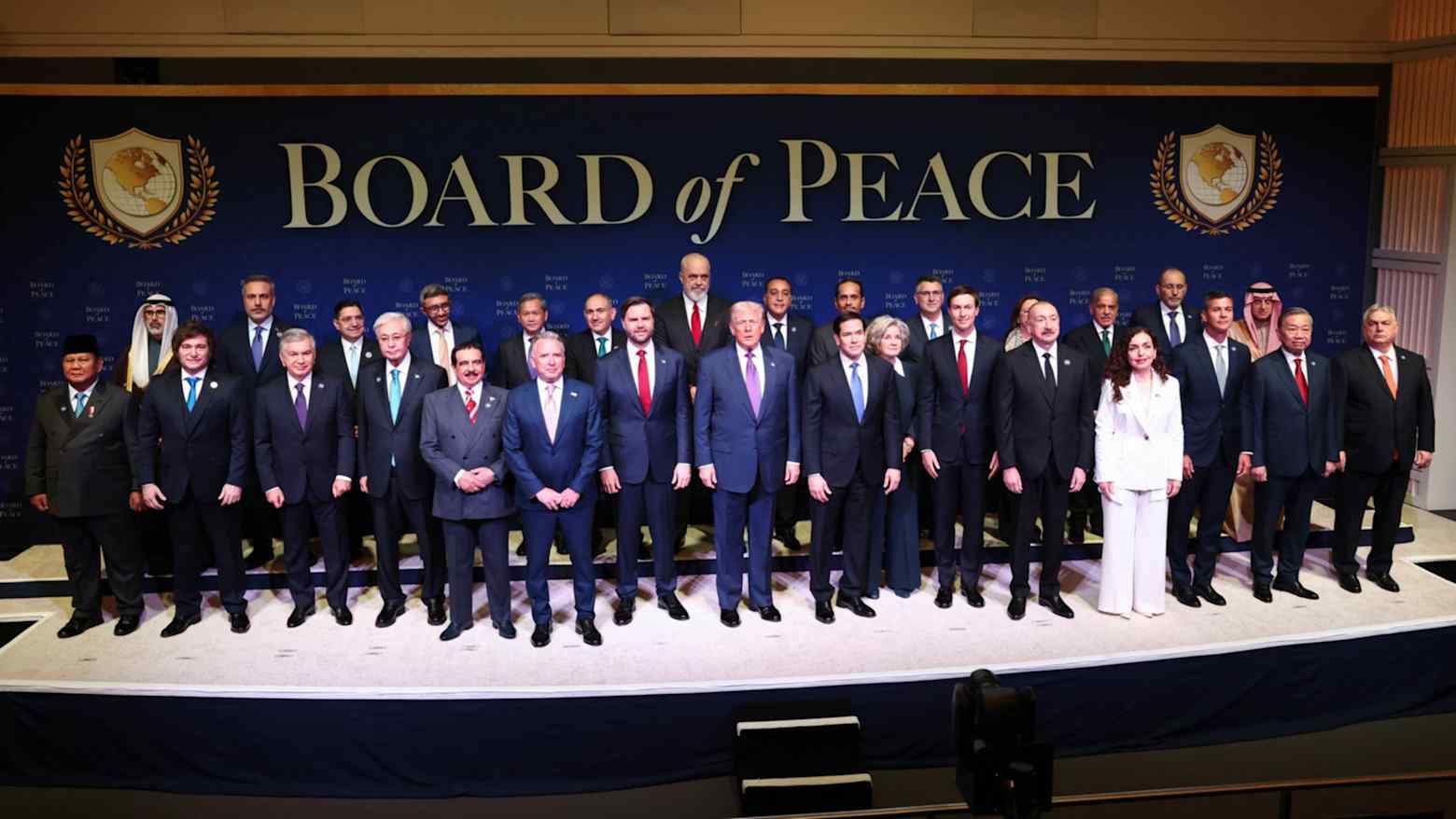
Trump described the inaugural session as “the most consequential board ever assembled”
The first official meeting of the Board of Peace took place on February 19, 2026, in Washington, D.C., under the leadership of U.S. President Donald Trump at the United States Institute of Peace. World leaders and diplomatic delegations from more than 20 countries participated, making it one of the largest international gatherings focused on resolving the Gaza crisis.
President Trump described the inaugural session as “the most consequential board ever assembled” and emphasized the goal of bringing sustainable peace and long‑term stability to the war‑torn Gaza Strip. The meeting brought together leaders from Asia, the Middle East, Europe, and other regions, including representatives from Indonesia, Azerbaijan, Kazakhstan, Saudi Arabia, Jordan, and Turkey, among others.
Financial commitments were a central focus. Contributing nations had pledged approximately $7 billion towards Gaza reconstruction, while the United States announced an additional $10 billion contribution to support relief, rebuilding, and stabilization efforts.
A major element of the initiative is the creation of an International Stabilisation Force intended to help maintain peace and security in Gaza. Some countries have pledged personnel for this force, with Indonesia committing up to 8,000 troops, and other contributors expected to provide additional forces and police units.
The Board’s broader mandate also includes coordinating long‑term development plans, rebuilding infrastructure, supporting humanitarian aid, and expanding peace efforts beyond Gaza to other conflict zones around the world.
However, the initiative has attracted scrutiny because it currently does not include direct Palestinian representation, raising questions about its legitimacy and acceptance among those most affected by the conflict.
Protests Against the Peace Meeting
While world leaders gathered inside for the Board of Peace meeting, protests erupted outside the U.S. Institute of Peace in Washington, D.C. Human rights activists, Palestinian supporters, and members of the community rallied to voice their objections to the forum’s composition and perceived direction.
Protesters sharply criticized the absence of Palestinian representatives in the peace process, arguing that decisions about Gaza cannot be made without direct Palestinian involvement. They held signs and chanted slogans such as “Gaza is not for sale” and “Free Palestine,” stressing that any peace plan that excludes the voices of Palestinians themselves lacks credibility and legitimacy.
Demonstrators also objected to the presence of Israel and certain nations in the Board, warning that unilateral or external decision‑making could undermine efforts to reach a truly lasting peace. Despite heavy police presence, the protesters remained vocal, insisting that Palestinian self‑determination and full implementation of international law must be central to any sustainable peace solution.
Trump Hails Pakistan’s Leaders, Shehbaz, Asim Munir in Spotlight
President Trump lauded Pakistani leaders at the Board meeting highlighting their key role in regional stability. He described Field Marshal General Asim Munir as a “great personality, an outstanding military leader, and a tough fighter,” noting his efforts in preventing conflict and saving millions of lives.
Trump also praised Prime Minister Shehbaz Sharif, saying,
“I like Prime Minister Shehbaz Sharif very much. He has always appreciated my efforts to mediate during conflicts,”
and acknowledged Pakistan’s contribution in maintaining peace during Pakistan‑India tensions.
Pakistan played a notable role at the Board of Peace meeting. Prime Minister Shehbaz Sharif attended the Washington gathering at the invitation of President Trump, accompanied by senior officials including Deputy Prime Minister and Foreign Minister Ishaq Dar.
In his address to the forum, PM Shehbaz underscored the urgent need to end ceasefire violations in Gaza and emphasized that lasting peace cannot be achieved without full respect for the truce. He highlighted the importance of Palestinian self‑determination and urged full implementation of United Nations Security Council resolutions on Palestine.
Shehbaz described the efforts to stabilize Gaza as a “golden chapter” in international diplomacy and reiterated Pakistan’s support for a peaceful, sovereign solution for the Palestinian people. He also praised President Trump for his role in conflict resolution and called on all parties to work together to sustain peace and rebuild Gaza.
Separately, Pakistan sought clarity on its participation in the proposed International Stabilisation Force, stressing that any deployment of Pakistani troops would be limited to peacekeeping duties and not involve the disarmament of any local groups, such as Hamas. Islamabad made it clear that Pakistan would join only if conditions aligned with peacekeeping objectives and international law.
Supporters in Pakistan view involvement with the Board of Peace as an opportunity for humanitarian leadership and diplomatic engagement on the world stage, while critics caution that participation must not compromise Pakistan’s historic support for Palestinian rights.